Last Updated on October 23, 2026 by D. Ruddy
A vibrant lawn starts with proper timing, and knowing when to fertilize lawn in Ohio fall can make all the difference. Ohio’s transitional climate means your grass needs a nutrient boost before winter to recover from summer stress and build strong roots. Fall fertilization helps your lawn store energy for a quicker green-up in spring while improving resistance to weeds and disease.
The best time to fertilize lawns in Ohio during fall is between late August and mid-October when grass is actively growing but temperatures are cooler. Apply fertilizer when soil temperatures are around 55-65°F for optimal nutrient absorption.
Why Fall Fertilization Matters for Ohio Lawns
Fall is the most critical season for lawn care in Ohio because cool-season grasses like Kentucky bluegrass, fescue, and ryegrass thrive in moderate temperatures. During this period, grass shifts its energy from top growth to root development, making it the perfect time to strengthen your lawn’s foundation.
According to Ohio State University Extension, lawns that receive proper fall fertilization can develop deeper root systems, which improves drought tolerance and disease resistance. This also helps crowd out weeds naturally by creating a dense, healthy turf.
Here’s why fall fertilization beats spring feeding:
- Root Growth: Cooler temperatures encourage root development rather than leafy growth
- Nutrient Storage: Grass stores carbohydrates in the roots for winter survival and spring regrowth
- Weed Prevention: A thick lawn from fall feeding naturally suppresses weed growth
- Disease Resistance: Stronger grass is less susceptible to common Ohio lawn diseases like dollar spot and brown patch
- Recovery Time: Summer stress (heat, drought, foot traffic) is repaired during fall growth
Tip: Test your soil before fertilizing. Ohio State University recommends soil testing every 3 years to determine exact nutrient needs.
Best Fertilizer Types for Ohio Fall Lawn Care
Not all fertilizers work equally well for Ohio’s fall conditions. The ideal fertilizer should have the right nitrogen-to-phosphorus-to-potassium (N-P-K) ratio to support root growth and winter hardiness. For most Ohio lawns, a slow-release nitrogen fertilizer with a ratio like 24-0-11 or 20-5-10 works best during fall.
Here’s a breakdown of what to look for:
| Fertilizer Type | N-P-K Ratio | Best For | Application Time |
|---|---|---|---|
| Slow-Release Granular | 24-0-11 | General fall feeding | Late August to October |
| High-Nitrogen Liquid | 30-0-4 | Quick greening | Early September |
| Winterizer | 10-0-20 | Root strengthening | Late October to November |
| Organic Options | 5-3-4 | Slow, natural feeding | Throughout fall |
For Ohio lawns, a fertilizer with 20-30% slow-release nitrogen is ideal because it feeds your grass gradually over 6-8 weeks. This prevents the rapid growth spurts that can make your lawn more susceptible to winter damage. The Scotts Turf Builder WinterGuard is a popular choice among Ohio homeowners for its balanced formula designed specifically for fall application.
Exact Timing When to Fertilize Lawn in Ohio Fall
Timing is everything when it comes to fall fertilization in Ohio. The state’s climate varies from the northern lake-influenced regions to the southern warmer areas, but there’s a general window that works for most of the state. The key is to align your fertilization schedule with your grass’s natural growth cycles and weather patterns.
Early Fall Application (Late August to Early September)
This first feeding of the fall season should be done when temperatures start to drop below 80°F consistently. At this time, your lawn is recovering from summer stress and beginning its fall growth phase. The goal here is to:
- Stimulate new growth to repair summer damage
- Encourage root development before winter
- Improve color and density
Recommended Fertilizer: Use a balanced fertilizer with a 3-1-2 or 4-1-2 N-P-K ratio. Apply about 0.5 to 1 pound of nitrogen per 1,000 square feet.
Mid-Fall Application (Late September to Mid-October)
About 6-8 weeks after your early fall feeding, it’s time for the second application. This is arguably the most important feeding of the year for Ohio lawns. During this period:
- Grass is focusing on root growth and carbohydrate storage
- Temperatures are ideal for nutrient absorption (soil temps between 55-65°F)
- Weed growth has slowed, reducing competition
Recommended Fertilizer: Switch to a fertilizer with a slightly higher potassium content (the third number in N-P-K) to help with winter hardiness. A 24-0-11 or similar ratio works well. Apply 1 pound of nitrogen per 1,000 square feet.
Late Fall/Winterizer Application (Late October to Early November)
The final feeding of the season should be applied just as your grass is entering dormancy. This application helps your lawn store nutrients for early spring growth. Key points:
- Apply when grass is still green but growth has slowed
- Use a fertilizer high in potassium to strengthen cell walls
- Avoid applying too late—fertilizer needs time to be absorbed before the ground freezes
Recommended Fertilizer: Use a winterizer formula with a ratio like 10-0-20. Apply 0.5 to 1 pound of nitrogen per 1,000 square feet.
Important: Never fertilize when the ground is frozen or if heavy rain is forecasted within 24 hours. This can lead to runoff and wasted fertilizer.
Step-by-Step Guide to Fertilizing Your Ohio Lawn in Fall
Proper application technique is just as important as choosing the right time and fertilizer. Follow these steps to ensure even coverage and maximum effectiveness.
Step 1: Prepare Your Lawn
Before applying fertilizer, your lawn needs some preparation to ensure the nutrients can reach the soil effectively.
- Mow the lawn: Cut your grass to about 2.5-3 inches. This height allows fertilizer to reach the soil while still protecting the grass blades.
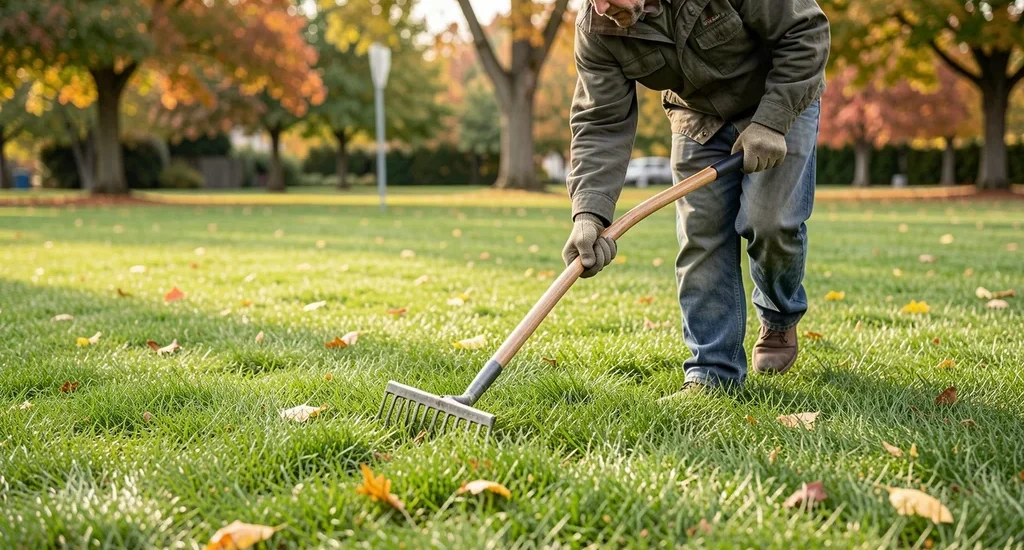
- Rake up debris: Remove leaves, sticks, and other debris that could block fertilizer from reaching the soil.
- Aerate if needed: If your soil is compacted (common in high-traffic areas), rent a core aerator to pull small plugs of soil. This improves fertilizer absorption.
- Water lightly: If the soil is very dry, water your lawn 1-2 days before fertilizing to ensure it’s slightly moist.
Step 2: Choose the Right Spread
For most homeowners, a broadcast or rotary spreader works best for even coverage. Here’s how to use it effectively:
- Calibrate your spreader: Each fertilizer brand provides spreader settings. Check the bag for the recommended setting for your specific spreader model.
- Fill the hopper: Only fill it halfway to avoid overloading and uneven distribution.
- Walk in patterns: Apply fertilizer in two perpendicular passes (north-south and east-west) to ensure even coverage.
- Overlap slightly: Overlap each pass by about 1-2 feet to prevent stripes of missed areas.
Pro Tip: Start by applying fertilizer to the perimeter of your lawn first, then work your way inward in a systematic pattern.
Step 3: Apply the Fertilizer
With your spreader ready, it’s time to apply the fertilizer. Follow these guidelines for best results:
- Start at the edges: Begin by fertilizing along the edges of your lawn, then move inward.
- Walk at a steady pace: Maintain a consistent walking speed to ensure even distribution.
- Avoid overlapping too much: While some overlap is good, too much can lead to uneven growth patterns.
- Shut off spreader when turning: Always close the spreader hopper when turning to prevent dumping fertilizer in one spot.
Warning: Never apply fertilizer near water sources, storm drains, or on hard surfaces like driveways or sidewalks. Sweep any fertilizer that lands on these surfaces back onto your lawn.
Step 4: Water Your Lawn
After applying fertilizer, proper watering is crucial to activate the nutrients and prevent burning your grass.
- Water immediately: Lightly water your lawn right after fertilizing to help the granules dissolve and start moving into the soil.
- Water deeply: Within 24-48 hours, give your lawn a deep watering (about 0.5 inches of water) to help the fertilizer penetrate the soil.
- Avoid heavy rain: If heavy rain is forecasted within 24 hours of application, delay fertilizing until after the rain.
Watering Tip: Early morning is the best time to water, as it reduces evaporation and prevents fungal growth that can occur with evening watering.
Ohio-Specific Considerations for Fall Fertilization
Ohio’s diverse climate and soil types mean that fertilization practices can vary slightly depending on your specific location within the state. Understanding these regional differences can help you fine-tune your approach.
Northern Ohio (Lake Erie Influence)
Northern Ohio, particularly areas near Lake Erie, has a slightly cooler climate and higher humidity. This region often experiences:
- Cooler fall temperatures that arrive earlier
- More consistent rainfall
- Higher clay content in soil
For this region:
- Start your fall fertilization slightly earlier (mid-August) because cooler temperatures arrive sooner
- Use slightly less fertilizer as the growing season is shorter
- Consider adding gypsum to improve clay soil structure
Central Ohio
Central Ohio has a more typical Midwestern climate with:
- Moderate temperatures
- Well-drained soils
- Consistent fall weather patterns
This is the region where the standard fall fertilization schedule works best:
- Early fall application: Late August to early September
- Mid-fall application: Late September to mid-October
- Late fall application: Late October to early November
Southern Ohio
Southern Ohio has a slightly warmer climate, similar to Kentucky. Characteristics include:
- Warmer fall temperatures that last longer
- More variable rainfall
- Often more sandy or loamy soils
For this region:
- Delay your early fall application until early September
- You may be able to extend your mid-fall application into late October
- Consider using a slightly higher nitrogen ratio to account for the longer growing season
| Region | First Application | Second Application | Winterizer |
|---|---|---|---|
| Northern Ohio | Mid-August | Early October | Late October |
| Central Ohio | Late August | Late September | Early November |
| Southern Ohio | Early September | Mid-October | Early November |
According to the Ohio Department of Natural Resources, about 60% of Ohio’s soils are classified as having medium to high fertility, but soil testing is still recommended to determine specific nutrient needs for your lawn.
Common Mistakes to Avoid When Fertilizing in Fall
Even with the best intentions, many Ohio homeowners make mistakes that can reduce the effectiveness of their fall fertilization or even harm their lawn. Being aware of these common pitfalls can help you achieve better results.
Over-Fertilizing
More isn’t always better when it comes to fertilizer. Over-application can lead to:
- Burning your lawn: Too much fertilizer can cause chemical burns, turning your grass brown
- Runoff pollution: Excess nutrients can wash into waterways, contributing to algae blooms
- Excessive top growth: Too much nitrogen late in the season can stimulate leafy growth at the expense of root development
- Wasted money: Your lawn can only absorb so many nutrients at once
Solution: Always follow the application rates on the fertilizer bag. When in doubt, err on the side of less rather than more.
Fertilizing at the Wrong Time
Timing is critical for fall fertilization. Common timing mistakes include:
- Too early: Fertilizing in late summer can stimulate growth during hot weather, stressing your lawn
- Too late: Applying fertilizer after the ground has frozen prevents proper absorption
- During drought: Fertilizer needs moisture to work effectively. Applying during dry spells can lead to poor results
- Before heavy rain: Heavy rainfall can wash away fertilizer before it has a chance to work
Solution: Stick to the recommended fall window (late August to early November) and check the weather forecast before applying.
Skipping Soil Testing
Many homeowners assume their lawn needs the same fertilizer every year, but soil conditions change. Skipping soil testing can lead to:
- Nutrient imbalances: Too much of one nutrient and not enough of another
- Wasted money: Applying nutrients your soil doesn’t need
- Environmental harm: Excess phosphorus can run off into waterways
Solution: Test your soil every 3 years. Ohio State University Extension offers affordable soil testing services.
Not Watering Properly
Fertilizer needs water to activate and move into the soil. Common watering mistakes include:
- Not watering at all: Fertilizer granules need moisture to dissolve and reach the roots
- Watering too much: Heavy watering immediately after application can wash away the fertilizer
- Watering at the wrong time: Evening watering can promote fungal growth
Solution: Lightly water immediately after application, then give your lawn a deep watering within 24-48 hours.
Using the Wrong Fertilizer
Not all fertilizers are created equal. Using the wrong type can lead to:
- Poor results: The wrong N-P-K ratio may not address your lawn’s specific needs
- Wasted money: Paying for nutrients your lawn doesn’t need
- Potential harm: Some fertilizers can be too strong for certain grass types
Solution: Choose a fertilizer specifically formulated for fall application and suited to Ohio’s cool-season grasses.
Tip: Keep a lawn care journal to track what fertilizers you’ve used, when you applied them, and the results. This helps you refine your approach over time.
Signs Your Ohio Lawn Needs Fall Fertilization
Sometimes it’s obvious when your lawn needs attention, but other times the signs are more subtle. Here’s what to look for to determine if your Ohio lawn would benefit from fall fertilization:
Visual Signs
Walk across your lawn and look for these visual indicators:
- Thin or sparse areas: Bare spots or areas where the grass is thin may indicate nutrient deficiency
- Dull or yellowing color: Healthy grass should be a vibrant green. Dull or yellowish areas often need nutrients
- Slow recovery: If footprints or mower tracks remain visible for hours, your grass may lack vigor
- Weed invasion: An increase in weeds often signals that your grass is weak and needs strengthening
- Uneven growth: Patches of faster or slower growing grass can indicate inconsistent nutrient levels
Physical Signs
Get up close and personal with your lawn to check for these physical signs:
- Weak root system: Dig up a small section of grass. If the roots are shallow (less than 2-3 inches deep), your lawn may need fall fertilization
- Thatch buildup: A thick layer of thatch (more than 0.5 inches) can prevent nutrients from reaching the soil
- Soil compaction: If the soil is hard and difficult to penetrate with a screwdriver or soil probe, it may need aeration and fertilization
- Slow spring green-up: If your lawn was slow to green up last spring, it may need more fall feeding to store nutrients for next year
Seasonal Signs
Consider the time of year and your lawn’s recent history:
- After summer stress: If your lawn suffered from drought, heat, or heavy use during summer, it likely needs fall recovery feeding
- Before winter: If you didn’t fertilize last fall, your lawn may be entering winter with depleted nutrient stores
- New lawns: If you’ve established a new lawn this year, it will benefit from extra fall feeding to establish strong roots
- After renovation: If you’ve recently overseeded or renovated your lawn, fall fertilization helps the new grass establish
Important: If your lawn shows signs of disease or pest damage, address these issues before fertilizing. Fertilizing a stressed lawn can sometimes make problems worse.
Organic vs Synthetic Fertilizers for Ohio Fall Lawn Care
When choosing a fertilizer for your Ohio lawn, one of the biggest decisions is whether to go with organic or synthetic options. Each has its advantages and disadvantages, and the best choice depends on your specific needs and preferences.
Organic Fertilizers
Organic fertilizers are derived from natural sources like compost, manure, bone meal, or plant byproducts. They offer several benefits for Ohio lawns:
- Slow-release nutrients: Organic fertilizers break down gradually, providing a steady supply of nutrients over time
- Improve soil health: They add organic matter to the soil, improving its structure and water-holding capacity
- Environmentally friendly: Less risk of runoff and water pollution compared to synthetic fertilizers
- Long-term benefits: Build soil fertility over time rather than providing a quick fix
Popular organic options for Ohio:
- Milorganite (5-4-0)
- Espoma Organic Lawn Food (9-0-0)
- Corn gluten meal (9-0-0)
Synthetic Fertilizers
Synthetic fertilizers are chemically formulated to provide specific nutrient ratios. They offer these advantages:
- Quick results: Nutrients are immediately available to the grass, providing fast greening and growth
- Precise nutrient ratios: You can choose exactly the N-P-K ratio your lawn needs
- Cost-effective: Generally less expensive per pound of nutrient than organic options
- Convenient: Easy to find at most garden centers and home improvement stores
Popular synthetic options for Ohio:
- Scotts Turf Builder WinterGuard (24-0-11)
- Miracle-Gro Water Soluble Lawn Food (30-0-6)
- Pennington UltraGreen Lawn Fertilizer (30-0-4)
| Factor | Organic Fertilizers | Synthetic Fertilizers |
|---|---|---|
| Nutrient Release | Slow (weeks to months) | Fast (days) |
| Cost per Application | Higher | Lower |
| Soil Health Impact | Improves over time | Neutral |
| Environmental Impact | Low runoff risk | Higher runoff risk if overapplied |
| Ease of Use | Can be bulkier to apply | Easy to apply |
| Longevity | Long-lasting | Short-term |
Many Ohio homeowners find that a combination approach works best: using organic fertilizers for regular maintenance and supplementing with synthetic fertilizers when quick results are needed, such as for early fall feeding.
Frequently Asked Questions
How often should I fertilize my Ohio lawn in the fall?
For most Ohio lawns, 2-3 applications during fall are ideal. The first should be in late August to early September, the second in late September to mid-October, and a final winterizer application in late October to early November. This schedule provides consistent nutrition throughout the fall growing season.
Can I fertilize my lawn too late in the fall in Ohio?
Yes, fertilizing too late can be problematic. If you apply fertilizer after the ground has frozen or when grass has gone completely dormant, the nutrients won’t be absorbed properly. In Ohio, early November is typically the latest you should apply fertilizer, though this can vary slightly by region.
What’s the best fertilizer for Ohio lawns in the fall?
The best fertilizer depends on your specific lawn needs, but for most Ohio homeowners, a slow-release nitrogen fertilizer with a 24-0-11 or 20-5-10 N-P-K ratio works well for fall applications. For the final winterizer application, look for a formula higher in potassium, like 10-0-20.
Should I water my lawn after fertilizing in the fall?
Absolutely. Watering is crucial after fertilizing to activate the nutrients and help them reach the soil. Lightly water immediately after application, then give your lawn a deep watering (about 0.5 inches) within 24-48 hours.
This ensures the fertilizer dissolves and penetrates the soil effectively.
Is it better to fertilize before or after aerating my Ohio lawn in fall?
For best results, aerate before fertilizing. Aeration helps relieve soil compaction and allows fertilizer to reach the root zone more effectively. The ideal sequence is: mow, aerate, overseed (if needed), then fertilize.
This order ensures maximum nutrient absorption and seed-to-soil contact.
Final Thoughts
Knowing when to fertilize lawn in Ohio fall is key to maintaining a healthy, vibrant lawn that can withstand winter stress and bounce back quickly in spring. By following the recommended timing (late August to early November), choosing the right fertilizer, and applying it properly, you’ll give your Ohio lawn the nutrients it needs to thrive. Remember to consider your specific region within Ohio, as timing can vary slightly based on local climate conditions.
With proper fall fertilization, you’ll enjoy a greener, denser lawn that’s more resistant to weeds, disease, and environmental stressors.