Every gardener eventually faces this decision. Wheelbarrow or garden cart? They both haul material. They both save your back. But they work in completely different ways. Pick the wrong one and you will be fighting your equipment every time you use it.
I own both. I have used both for years. Here is the honest breakdown of which one you should buy based on your property, your projects, and your physical abilities.
The Core Difference in One Sentence
A wheelbarrow is a one-wheel tool designed for maneuverability and precise dumping. A garden cart is a two-wheel or four-wheel tool designed for stability and easy loading.
That one design difference – the number of wheels – changes everything about how each tool performs in your garden.
How a Wheelbarrow Actually Works
A wheelbarrow balances on a single wheel with two handles you lift and push. The single wheel acts as a pivot point. This gives you incredible maneuverability. You can turn on a dime. You can weave through narrow garden paths. You can tilt the barrow sideways to pour material exactly where you want it.
But that single wheel is also the weakness. Wheelbarrows tip sideways if loaded unevenly. They tip forward if you hit a bump. They require constant balance. If you have back problems, weak arms, or poor balance, a wheelbarrow can be frustrating and even dangerous with heavy loads.
🍂 The Silent Lawn Killer: Damp Leaves Will Suffocate Your Grass
Trapped wet leaves create a breeding ground for destructive snow mold. Clear the yard fast with a high-power cordless blower before the ground freezes.
A properly loaded wheelbarrow should have about 70% of the weight over the wheel and 30% on the handles. If you feel like you are lifting the entire load with your arms, the weight is too far back. Move the load forward.
How a Garden Cart Works
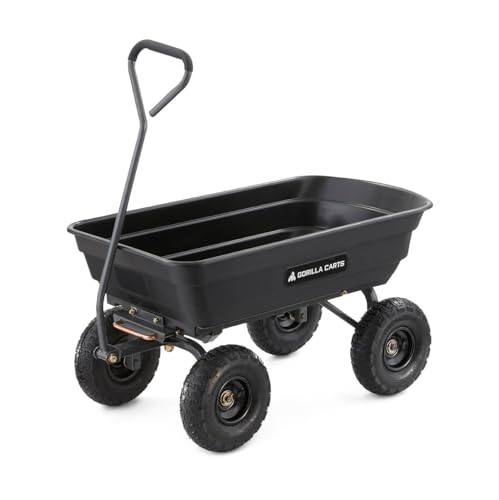
A garden cart has two or four wheels. The multiple wheels provide a stable base. The cart stays upright on its own. You can load it unevenly. You can park it on a slight slope. You can let go of the handle and it will not tip over.
Many garden carts have a dump feature – a latch you release that lets the bed tilt and empty the contents. This eliminates the lifting and tipping motion that wheelbarrows require. For heavy loads like gravel or wet soil, the dump feature saves significant back strain.
The tradeoff is maneuverability. A cart with two or four wheels is wider than a single-wheel barrow. It cannot turn as sharply. It will not fit through a 30-inch garden gate if the cart is 36 inches wide. Garden carts also tend to be larger overall, which means they need more storage space.
Side-by-Side Comparison
| Feature | Wheelbarrow | Garden Cart |
|---|---|---|
| Stability | Tips easily | Very stable |
| Maneuverability | Excellent – tight turns | Good – wider turning radius |
| Dumping | Manual lift and tip | Often has dump feature |
| Capacity (typical) | 4-6 cu ft / 300 lbs | 4-6 cu ft / 300-600 lbs |
| Storage space | Smaller footprint | Larger footprint |
| Terrain | Good on all surfaces | Needs relatively flat ground |
| Physical effort | Higher – requires balance and lifting | Lower – stable and dumps easily |
| Best for | Tight spaces, precise dumping | Open spaces, heavy loads |
| Price range | $50-$150 | $75-$300 |
When a Wheelbarrow Is the Better Choice
You have narrow garden paths. If your garden has 30-inch gates, tight spaces between raised beds, or paths that wind through shrubs, a single-wheel barrow fits where a cart cannot. The maneuverability of a wheelbarrow is unmatched in tight quarters.
You need to pour material precisely. Wheelbarrows dump exactly where you tip them. Pouring soil into a planting hole. Pouring concrete into a form. Placing gravel at the base of a post. The single-wheel pivot gives you fine control over the pour location.
🍂 The Silent Lawn Killer: Damp Leaves Will Suffocate Your Grass
Trapped wet leaves create a breeding ground for destructive snow mold. Clear the yard fast with a high-power cordless blower before the ground freezes.
You are on a budget. A decent wheelbarrow costs $50 to $70. A comparable garden cart costs $90 to $130. If money is tight, a wheelbarrow gets the job done for less.
You have limited storage space. A wheelbarrow can be hung on a wall or leaned against a corner. A garden cart needs floor space. In a small shed, that matters.
You are in good physical shape. If you have a strong back, good balance, and no physical limitations, a wheelbarrow works great. The balance requirement is not a problem for you.
When a Garden Cart Is the Better Choice
You haul heavy loads regularly. A cart with a 600-pound capacity and a dump feature handles gravel, concrete, and wet soil without straining your body. The dump latch replaces the lifting and tipping that wheelbarrows require.
You have balance issues or a bad back. A garden cart stays upright on its own. It will not tip if you load it funny. It will not fall over if you let go. For anyone with physical limitations, a cart is much safer and less frustrating.
You have wide, open spaces. If your garden has wide paths, large gates, and open lawns between work areas, the cart’s extra width does not matter. You get all the stability benefits without the maneuverability penalty.
🍂 The Silent Lawn Killer: Damp Leaves Will Suffocate Your Grass
Trapped wet leaves create a breeding ground for destructive snow mold. Clear the yard fast with a high-power cordless blower before the ground freezes.
You want a dump feature. Unloading a wheelbarrow means lifting the handles and tipping the entire load. With 300 pounds of wet soil, that is a workout. A dump cart empties with a latch pull. Your back will thank you.
You tow behind a lawn tractor. Many garden carts have hitch pins for towing. You can load the cart, hitch it to your tractor, and pull the load without walking. Wheelbarrows generally cannot be towed.
What About 2-Wheel Garden Carts?
Two-wheel carts like the Gorilla Carts GOR4PS are a middle ground. They are more stable than a single-wheel barrow but more maneuverable than a 4-wheel cart. The two wheels sit near the front. You lift the back handle to move it, similar to a wheelbarrow but with zero tipping risk.
A 2-wheel cart is the best choice for most homeowners. You get the stability that a single-wheel barrow lacks without giving up too much maneuverability. The Gorilla Carts design, with its dump feature, is effectively a modern wheelbarrow replacement.
Can You Use a Garden Wagon Instead?
A collapsible garden wagon (like the Mac Sports folding wagon) is a third option. These are lightweight fabric carts with four small wheels. They fold flat for storage. They are great for light loads – bags of soil, potted plants, tools, harvest baskets.
But wagons are not substitutes for a wheelbarrow or heavy cart. They max out at 150 pounds. The small wheels struggle on rough terrain. The fabric sides can tear. A wagon is a great secondary tool for light work, not a primary material hauler.
🍂 The Silent Lawn Killer: Damp Leaves Will Suffocate Your Grass
Trapped wet leaves create a breeding ground for destructive snow mold. Clear the yard fast with a high-power cordless blower before the ground freezes.
My Recommendation Based On Your Situation
Small garden, tight paths, light loads: Get a traditional single-wheel wheelbarrow. A 4-cubic-foot poly tray model like the Ames Never-Leak ($50) handles light work and fits anywhere.
Medium to large garden, varied projects: Get a 2-wheel dump cart. The Gorilla Carts GOR4PS ($90) gives you stability, a dump feature, and enough capacity for most homeowner projects. This is what I recommend for 80% of people.
Large property, heavy materials: Get a heavy-duty dump cart. The Gorilla Carts GOR6PS ($130) with 600-pound capacity handles anything you can throw at it. Add a wheelbarrow as a secondary tool for tight, precise work.
Bad back, poor balance, arthritis: Get a 2-wheel dump cart. The stability and dump feature eliminate the two things that make wheelbarrows hard on your body – balancing and tipping.
Frequently Asked Questions
Can I use a garden cart as a wheelbarrow?
Yes, for most tasks. You lose some precision when pouring material but gain stability. If you dump mulch into a wide garden bed, the cart works the same. If you need to pour concrete into a narrow form, a wheelbarrow is better.
Which is better for moving firewood?
A garden cart with high sides. Firewood is heavy and awkward. The stability of a cart prevents logs from tipping out. A wheelbarrow loaded with firewood tips easily if the logs shift. The Gorilla Carts GOR6PS is excellent for firewood.
🍂 The Silent Lawn Killer: Damp Leaves Will Suffocate Your Grass
Trapped wet leaves create a breeding ground for destructive snow mold. Clear the yard fast with a high-power cordless blower before the ground freezes.
Which is cheaper to maintain?
Both are low-maintenance. Wheelbarrows have one tire to inflate and one bearing to oil. Garden carts have multiple tires. Flat-free tires (available on both) eliminate the inflation issue entirely. Steel trays need rust prevention on both types.
Can I build my own garden cart?
Yes. Many DIY plans exist for wooden garden carts with bicycle wheels. The Vermont Garden Cart design is frequently replicated. Building your own makes sense if you have the tools and skills – you can customize the size and save money on materials. Expect to spend $50 to $100 on wheels, hardware, and wood.
What is the best wheelbarrow for an elderly person?
None. Skip the wheelbarrow entirely and get a 2-wheel garden cart with a dump feature. The stability and easy unloading are far more important than maneuverability for elderly gardeners. The Gorilla Carts GOR4PS or GOR6PS are the safest options.
🍂 The Silent Lawn Killer: Damp Leaves Will Suffocate Your Grass
Trapped wet leaves create a breeding ground for destructive snow mold. Clear the yard fast with a high-power cordless blower before the ground freezes.