Last Updated on October 23, 2026 by D. Ruddy
If you want a vibrant lawn next spring, knowing when to fertilize lawn in Colorado fall is crucial. Colorado’s unique climate with its cold winters and dry air means timing your fertilization right can make all the difference. Applying fertilizer too early or too late can waste your effort or even harm your grass.
This guide will help you pinpoint the perfect window and choose the right approach for your lawn’s needs.
The best time to fertilize your lawn in Colorado in the fall is between mid-September and early October. This timing allows your grass to absorb nutrients before winter dormancy and encourages strong root growth for a healthier spring.
Why Fall Fertilization Matters for Colorado Lawns
Fall fertilization is the most important feeding of the year for Colorado lawns. During this season, grass shifts its energy from top growth to root development, making it the ideal time to strengthen your turf for winter survival and spring recovery.
Colorado’s climate presents unique challenges with its temperature swings and dry conditions. Fertilizing in the fall helps your lawn:
- Recover from summer stress caused by heat and drought
- Build stronger roots to withstand winter cold
- Store essential nutrients for early spring green-up
- Improve resistance to common Colorado lawn diseases
- Outcompete weeds that might otherwise take over
According to Colorado State University Extension, lawns that receive proper fall fertilization can green up 2-3 weeks earlier in the spring and maintain better color throughout the growing season.
Tip: Avoid fertilizing too late in the season. Applications after mid-October may not provide enough time for proper absorption before winter dormancy.
Best Fertilizer Types for Colorado Fall Lawn Care
Choosing the right fertilizer is just as important as timing your application. Colorado lawns typically benefit from a balanced approach that addresses both immediate needs and long-term soil health.
Here are the most effective fertilizer types for fall application in Colorado:
| Fertilizer Type | NPK Ratio | Best For | Application Timing |
|---|---|---|---|
| Slow-release granular | 20-5-10 or 16-4-8 | General fall feeding | Mid-September to early October |
| High-nitrogen | 30-0-4 or 28-0-6 | Quick green-up | Early September |
| Winterizer | 10-0-20 or 8-0-24 | Root development | Late September to mid-October |
| Organic | 5-3-1 or 6-2-0 | Soil health improvement | Early to mid-September |
| Liquid fertilizer | 20-10-10 | Quick absorption | Mid to late September |
For most Colorado homeowners, a slow-release granular fertilizer with a balanced NPK ratio (like 20-5-10) offers the best combination of immediate results and long-term benefits. These fertilizers feed your lawn gradually over 6-8 weeks, which aligns perfectly with the fall growing season.
Step-by-Step Guide to Fertilizing Your Colorado Lawn in Fall
Proper application is key to getting the most from your fall fertilization. Follow these steps to ensure even coverage and maximum effectiveness.
Step 1: Test Your Soil
Before applying any fertilizer, test your soil to determine its current nutrient levels and pH. Colorado soils often tend to be alkaline (high pH), which can affect nutrient availability.
- Use a home soil test kit or send a sample to your local Colorado State University Extension office
- Test for pH, nitrogen, phosphorus, and potassium levels
- Aim for a pH between 6.0 and 7.0 for most Colorado turfgrasses
- If your pH is too high (common in Colorado), consider applying sulfur to lower it
Step 2: Choose the Right Time of Day
Timing your application during the right part of the day can improve effectiveness and reduce waste.
- Apply fertilizer in the early morning when dew is present to help granules stick to the grass blades
- Avoid applying during the heat of the day as this can cause the fertilizer to evaporate or burn the grass
- Ensure no rain is forecast for at least 24-48 hours after application to prevent runoff
- Water lightly after application if no rain is expected within 24 hours
Step 3: Prepare Your Lawn
Proper preparation ensures your fertilizer reaches the soil and roots where it can do the most good.
- Mow your lawn to a height of about 2-2.5 inches, which is ideal for most Colorado turfgrasses in fall
- Remove any leaves or debris that might block the fertilizer from reaching the soil
- Aerate your lawn if it has heavy thatch or compacted soil (common in Colorado clay soils)
- Rake up any grass clippings or debris after mowing
- Water your lawn lightly the day before application to ensure soil moisture
Step 4: Apply the Fertilizer
Even application is crucial for consistent results across your entire lawn.
- Use a broadcast spreader for large areas and a drop spreader for more precision
- Calibrate your spreader according to the fertilizer manufacturer’s instructions
- Apply fertilizer in two perpendicular directions (north-south, then east-west) for even coverage
- Overlap slightly on each pass to avoid missing any areas
- Keep the spreader moving at a consistent pace to prevent over-application in any one spot
Step 5: Water Properly After Application
Watering after fertilization helps activate the nutrients and move them into the soil where roots can access them.
- Water lightly immediately after application to help dissolve granular fertilizer
- Apply about 0.25-0.5 inches of water to ensure the fertilizer reaches the root zone
- Avoid heavy watering that might wash away the fertilizer
- If rain occurs within 24 hours, you may not need to water
- Continue regular watering (about 1 inch per week) throughout the fall
Important: Never apply fertilizer to frozen ground or when temperatures are expected to drop below freezing within 24 hours, as this can lead to runoff and waste.
Colorado-Specific Fertilizing Considerations
Colorado’s diverse climate zones and elevation changes mean that fertilization practices can vary significantly across the state. What works in Denver might not be optimal for Fort Collins or Colorado Springs.
Elevation Effects on Fertilization
Colorado’s varying elevations affect temperature, growing seasons, and grass types, all of which influence your fertilization schedule.
| Elevation | Zone | Fertilization Window | Notes |
|---|---|---|---|
| 3,000-5,000 ft | Front Range (Denver, Boulder) | Mid-Sept to early Oct | Standard schedule |
| 5,000-7,000 ft | Foothills (Golden, Evergreen) | Early to mid-Sept | Shorter growing season |
| 7,000-9,000 ft | Mountain (Vail, Breckenridge) | Late Aug to early Sept | Very short window |
| Below 3,000 ft | Western Slope (Grand Junction) | Late Sept to mid-Oct | Warmer fall temps |
Higher elevations experience earlier frosts and shorter growing seasons, so fertilization needs to happen earlier in the fall. Conversely, lower elevations and the Western Slope have longer growing seasons and can fertilize later into the fall.
Grass Types Common in Colorado
Colorado lawns typically feature cool-season grasses that thrive in the state’s climate. The most common types include:
- Kentucky Bluegrass: The most popular choice for Colorado lawns, known for its lush appearance and good cold tolerance. Requires regular fertilization and watering.
- Tall Fescue: Drought-tolerant and durable, making it ideal for Colorado’s dry climate. Requires less frequent fertilization than bluegrass.
- Fine Fescue: Low-maintenance and shade-tolerant, good for areas with less sunlight. Requires less nitrogen than other grasses.
- Perennial Ryegrass: Fast-germinating and often used in blends. Needs more frequent fertilization for optimal appearance.
- Buffalograss: Native to Colorado, drought-resistant, and low-maintenance. Requires less fertilization than cool-season grasses.
Each grass type has different fertilization needs. Kentucky Bluegrass, for example, benefits from more frequent feeding, while Buffalograss may only need one fall application. Always check the specific recommendations for your grass type.
Common Mistakes to Avoid When Fertilizing in Fall
Even with the best intentions, many Colorado homeowners make mistakes that can reduce the effectiveness of their fall fertilization or even harm their lawns. Being aware of these common pitfalls can help you achieve better results.
- Over-fertilizing: Applying too much fertilizer can burn your grass, lead to excessive top growth at the expense of root development, and contribute to water pollution through runoff. Always follow the manufacturer’s recommended rates.
- Under-fertilizing: Using too little fertilizer won’t provide the nutrients your lawn needs to recover from summer stress and prepare for winter. This can result in a weak lawn that’s more susceptible to disease and weeds.
- Fertilizing at the wrong time: Applying fertilizer too early in the fall can promote top growth that will be damaged by frost. Too late, and the grass won’t have time to absorb the nutrients before going dormant.
- Skipping soil testing: Without knowing your soil’s current nutrient levels and pH, you might be applying fertilizer your lawn doesn’t need or missing essential nutrients that are deficient.
- Not watering properly: Fertilizer needs moisture to dissolve and reach the root zone. Failing to water after application can result in wasted fertilizer and poor results.
- Using the wrong fertilizer type: Not all fertilizers are created equal. Using a quick-release fertilizer when a slow-release would be better, or vice versa, can lead to suboptimal results.
- Ignoring weather conditions: Applying fertilizer before a heavy rain can wash it away before it has a chance to work. Similarly, fertilizing during a drought can stress your lawn.
Warning: Never apply fertilizer to a lawn that’s already stressed from drought, disease, or pest damage. Always address these issues first, then fertilize to help the lawn recover.
Signs Your Lawn Needs Fall Fertilization
Not sure if your lawn actually needs fall fertilization? Look for these telltale signs that your turf could benefit from a nutrient boost before winter.
Visual Indicators
- Thinning turf: If your lawn looks sparse with visible soil between grass blades, it’s a sign that the grass isn’t growing as vigorously as it should.
- Loss of color: A lawn that’s lost its vibrant green color and taken on a yellowish or brownish hue is likely nutrient-deficient.
- Slow recovery: If your lawn takes a long time to bounce back from foot traffic, mowing, or summer stress, it may need more nutrients.
- Weed invasion: An increase in weeds often indicates that your grass is weak and not competing well for space and resources.
- Patchy growth: Uneven growth patterns with some areas thriving while others struggle suggest inconsistent nutrient distribution.
Physical Tests
You can perform some simple tests to assess your lawn’s health:
- The tug test: Grab a handful of grass and tug gently. If it pulls up easily with little resistance, your lawn may have weak roots due to inadequate nutrition.
- The color test: Compare the color of your grass to a healthy neighbor’s lawn. If yours is noticeably lighter, it may need fertilization.
- The growth test: If your grass isn’t growing at all in the fall (when it should be actively growing), it may be nutrient-deficient.
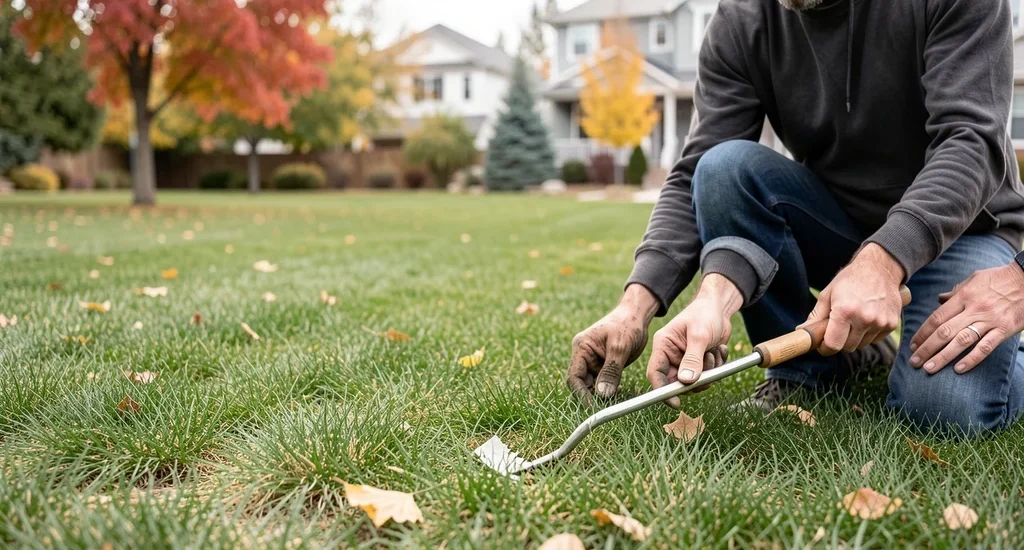
- The thatch test: Dig up a small section of your lawn. If you see more than 0.5 inches of thatch (a layer of dead grass and debris), your lawn may need fertilization to promote healthier growth.
Seasonal Signs
Certain seasonal changes can also indicate a need for fall fertilization:
- If your lawn browned out significantly during the summer and hasn’t recovered
- If spring green-up was slower or less vibrant than in previous years
- If your lawn seems to require more frequent watering to maintain its color
- If you notice more bare spots developing after summer stress
- If your lawn seems to be losing its density year after year
Organic vs. Synthetic Fertilizers for Colorado Lawns
When choosing a fertilizer for your Colorado lawn, one of the key decisions is whether to go with organic or synthetic options. Each has its advantages and disadvantages, and the best choice depends on your specific needs and preferences.
| Factor | Organic Fertilizers | Synthetic Fertilizers |
|---|---|---|
| Nutrient release | Slow (weeks to months) | Fast (days to weeks) |
| Nutrient content | Lower (typically 5-10% N-P-K) | Higher (typically 20-30% N-P-K) |
| Soil improvement | Yes (adds organic matter) | No (only adds nutrients) |
| Cost | Higher per pound of nutrient | Lower per pound of nutrient |
| Application frequency | More frequent (every 6-8 weeks) | Less frequent (every 8-12 weeks) |
| Environmental impact | Lower (natural, less runoff) | Higher (potential for runoff) |
Organic fertilizers are derived from natural sources like compost, manure, bone meal, or plant byproducts. They release nutrients slowly as they break down, which can provide more consistent feeding over time. They also improve soil structure and microbial activity, which benefits your lawn in the long run.
Synthetic fertilizers, on the other hand, are manufactured to provide specific nutrient ratios in a readily available form. They work quickly to address immediate nutrient deficiencies and are often more cost-effective for large lawns. However, they don’t improve soil health and can contribute to runoff if not applied properly.
Frequently Asked Questions
How often should I fertilize my lawn in Colorado during the fall?
For most Colorado lawns, one application in mid to late September is sufficient for fall fertilization. However, if your lawn is in poor condition, you might consider a second light application in early October. Remember that over-fertilizing can be as harmful as under-fertilizing, so it’s important to follow recommended rates and timing.
Can I fertilize my lawn in late October or November in Colorado?
It’s generally not recommended to fertilize after mid-October in most of Colorado. By this time, grass is beginning to go dormant for winter, and the nutrients may not be effectively absorbed. Late fertilization can also contribute to runoff and water pollution.
The only exception might be in lower elevation areas with milder winters, where a very early November application might still be effective.
What’s the best fertilizer ratio for Colorado lawns in the fall?
For fall fertilization in Colorado, look for a fertilizer with a higher nitrogen content and a balanced or slightly higher potassium ratio. A good general-purpose fall fertilizer might have an NPK ratio of 20-5-10 or 16-4-8. The nitrogen promotes blade growth and color, while the potassium helps with root development and winter hardiness.
Phosphorus is less critical in the fall unless your soil test indicates a deficiency.
Should I aerate before fertilizing in the fall?
Yes, aerating your lawn before fall fertilization can significantly improve the effectiveness of your fertilizer application. Aeration creates small holes in your lawn that allow water, air, and nutrients to penetrate deeper into the soil, reaching the root zone where they’re most needed. This is especially beneficial in Colorado where clay soils can become compacted, preventing proper nutrient absorption.
Aim to aerate about 1-2 weeks before fertilizing to give your lawn time to recover from the process.
How long after fertilizing should I wait to mow my lawn?
It’s generally recommended to wait at least 24-48 hours after fertilizing before mowing your lawn. This gives the fertilizer time to dissolve and begin working. When you do mow, make sure your mower blades are sharp to avoid tearing the grass, and never remove more than one-third of the grass blade length at a time.
Also, be sure to collect the grass clippings after fertilizing to prevent them from spreading fertilizer unevenly across your lawn.
Final Thoughts
Knowing when to fertilize lawn in Colorado fall is the key to a healthier, more resilient lawn that can withstand winter stresses and bounce back stronger in the spring. The ideal window is typically mid-September to early October, but this can vary based on your specific location, elevation, and grass type. Remember to choose the right fertilizer, apply it correctly, and avoid common mistakes like over-fertilizing or poor timing.
With proper fall care, your Colorado lawn will be better prepared to face the challenges of winter and reward you with lush, green growth when spring arrives.