Last Updated on October 22, 2026 by D. Ruddy
Dealing with unsightly mounds of dirt and tunnels ruining your lawn can be frustrating. Moles in yard are a common problem for homeowners, as these small mammals dig extensive burrow systems in search of grubs and insects. While they don’t directly harm plants, their activity can damage roots and create an uneven, messy landscape.
This guide covers proven methods to identify, prevent, and eliminate moles so you can restore your yard to its former glory.
You can get rid of moles in your yard by using traps, repellents, or natural deterrents like castor oil. The fastest method is trapping, but prevention through lawn care and grub control is the long-term solution.
Signs You Have Moles in Your Yard
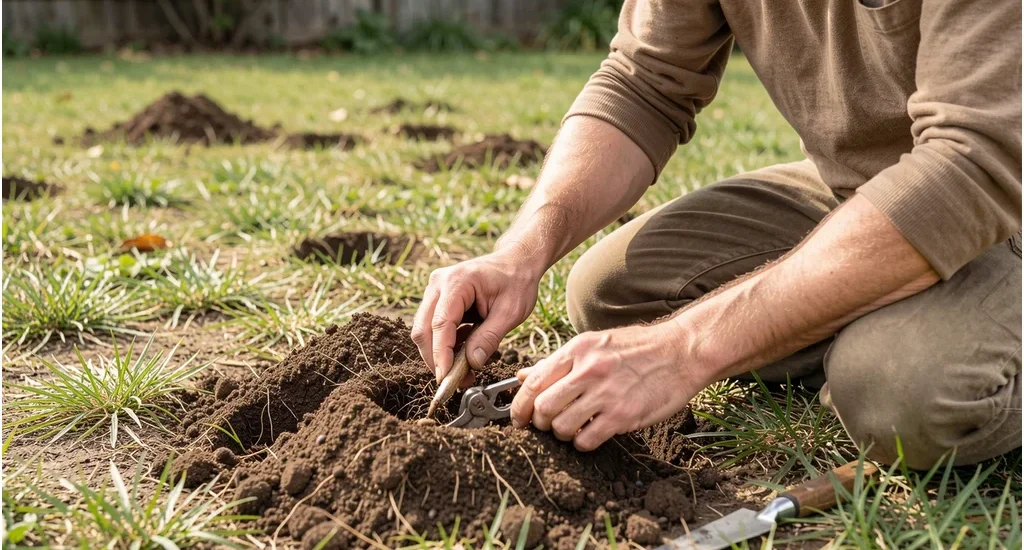
Moles are active year-round, but their presence becomes most obvious in spring and fall. The first sign is usually the appearance of small, volcano-shaped mounds of dirt—these are molehills, created as they push soil to the surface while digging. Unlike gopher mounds, molehills have no visible holes on top.
Another telltale sign is the network of raised, squiggly tunnels just beneath the surface of your lawn. These ridges are created as moles search for food, primarily earthworms and grubs. You may also notice patches of dead or dying grass where their tunneling has disrupted the root systems.
- Fresh molehills: Small, circular piles of loose soil, often 2-6 inches tall
- Surface tunnels: Raised, meandering ridges in the grass
- Soft, spongy ground: Areas where the soil feels loose underfoot
- Wilting plants: Grass or plants that appear unhealthy due to root damage
- Increased insect activity: Moles attract predators like snakes and owls
According to the University of Nebraska-Lincoln Extension, a single mole can create up to 100 feet of tunnels in just one day. This rapid digging is why infestations can seem to appear overnight.
Why Moles Invade Your Yard
Moles are not after your plants—they are insectivores with a particular taste for grubs, earthworms, and other soil-dwelling insects. Your yard becomes attractive to them when it offers a rich food supply. Overwatered lawns, excessive thatch, and poor drainage create ideal conditions for grubs, which in turn attract moles.
Soil type also plays a role. Moles prefer loose, moist soil that is easy to dig through. Sandy or loamy soils are particularly inviting.
Additionally, yards with minimal predators (like owls or snakes) or those bordered by wooded areas may see more mole activity.
| Factor | Why It Attracts Moles |
|---|---|
| High grub population | Primary food source for moles |
| Moist, loose soil | Easy to tunnel through |
| Overwatered lawn | Encourages grub survival |
| Thick thatch layer | Provides shelter and food |
| Lack of predators | Moles face less risk |
Reducing these attractants is key to long-term mole prevention. A study by the Journal of Agricultural and Urban Entomology found that yards with high grub populations were 70% more likely to experience mole activity.
How to Confirm It’s Moles and Not Gophers or Voles
Before attacking the problem, it’s important to correctly identify the culprit. Moles, gophers, and voles all create tunnels and mounds, but their behavior and damage patterns differ significantly.
Moles create surface tunnels and small, volcano-like mounds with no visible holes. Gophers, on the other hand, dig deeper and create larger, crescent-shaped mounds with visible holes. Voles create shallow burrows with visible entry points and often gnaw on plant stems and roots at the surface.
Tip: To test for moles, stomp down a section of tunnel. If it’s a mole tunnel, it will often be repaired within 24 hours.
| Pest | Mound Shape | Tunnel Location | Diet |
|---|---|---|---|
| Moles | Small, volcano-shaped | Just below surface | Insects, grubs, worms |
| Gophers | Large, crescent-shaped | Deep underground | Roots, vegetation |
| Voles | Small, with visible holes | Shallow, near surface | Plants, seeds, roots |
Misidentifying the pest can lead to ineffective control methods. For instance, gopher traps won’t work for moles, and mole repellents won’t deter voles.
Best Methods to Remove Moles from Your Yard
When it comes to getting rid of moles, you have several effective options. The best approach depends on your preferences, budget, and the severity of the infestation. Below are the most proven methods, ranked by effectiveness.
- Trapping (Most effective for immediate results)
- Repellents (Good for prevention and mild infestations)
- Natural home remedies (Eco-friendly but less reliable)
- Professional extermination (Best for large-scale problems)
1. Trapping: The Fastest Solution
Trapping is considered the most effective way to remove moles from your yard. Scissor-jaw traps and harpoon traps are the most common types. Scissor-jaw traps are placed over active tunnels, while harpoon traps are inserted into the ground and triggered when the mole pushes up the soil.
To use a trap effectively:
- Locate an active tunnel by flattening a section and waiting to see if it’s rebuilt
- Set the trap according to the manufacturer’s instructions
- Cover the trap with a bucket or box to protect pets and children
- Check the trap daily and remove any captured moles
- Relocate traps to new active tunnels if no moles are caught within 3-4 days
Warning: Always wear gloves when handling traps to avoid leaving human scent, which may deter moles.
Best For: Homeowners who want quick, permanent results and are comfortable handling traps.
2. Repellents: Chemical and Natural Options
Repellents work by making your yard less appealing to moles. Chemical repellents often contain castor oil, which irritates moles’ digestive systems. Natural repellents include plant-based solutions like garlic, cayenne pepper, or predator urine (like coyote or fox urine).
To apply repellents:
- Follow the product instructions for dilution and application rates
- Apply evenly across the affected areas, focusing on active tunnels
- Reapply after rain or watering, as most repellents are not long-lasting
- Use a sprayer for liquid repellents or a spreader for granular products
- Combine with other methods for better results
| Repellent Type | Effectiveness | Duration | Eco-Friendly? |
|---|---|---|---|
| Castor oil-based | High | 2-4 weeks | Yes |
| Garlic/cayenne | Moderate | 1-2 weeks | Yes |
| Predator urine | Moderate | 3-4 weeks | Yes |
| Chemical granules | High | 4-6 weeks | No |
Best For: Homeowners who prefer a hands-off approach and want to prevent moles from returning.
3. Natural Home Remedies
If you prefer a DIY approach, several home remedies can help deter moles. While not as effective as commercial products, these methods are safe, eco-friendly, and easy to implement.
Popular natural remedies include:
- Castor oil spray: Mix 2 tablespoons of castor oil with 1 gallon of water and 1 tablespoon of dish soap. Spray on tunnels and molehills.
- Cayenne pepper: Sprinkle powdered cayenne pepper near active tunnels or mix with water to create a spray.
- Garlic and chili: Blend garlic cloves and chili peppers with water, strain, and spray the liquid on affected areas.
- Vibrating devices: Solar-powered vibrating stakes can irritate moles and drive them away.
- Predator decays: Place used cat litter (from an outdoor cat) near tunnels to mimic predator presence.
Important: Natural remedies may need frequent reapplication, especially after rain, to remain effective.
Best For: Eco-conscious homeowners who prefer chemical-free solutions and have mild mole problems.
4. Professional Extermination
For severe or persistent mole infestations, hiring a professional pest control service may be the best option. Professionals have access to commercial-grade traps, repellents, and fumigation methods that are not available to the general public.
When to consider professional help:
- You’ve tried multiple DIY methods without success
- The infestation covers a large area of your yard
- You’re uncomfortable handling traps or chemicals
- You want a guaranteed solution with follow-up services
- You suspect other pests (like gophers or voles) are also present
Professional services typically start with an inspection to identify the extent of the infestation and the best treatment plan. They may use a combination of trapping, repellents, and habitat modification to ensure long-term results.
Best For: Homeowners with large or stubborn infestations who want a hassle-free, expert solution.
Step by Step Guide to Trapping Moles
Trapping is the most reliable method for removing moles from your yard. Follow this step-by-step guide to maximize your success.
Step 1: Identify Active Tunnels
Not all tunnels are actively used by moles. To avoid wasting time on inactive tunnels, you need to identify which ones are currently in use.
- Locate a section of tunnel and flatten it with your foot or a shovel.
- Mark the spot with a stick or flag.
- Check the spot after 24 hours. If the tunnel has been rebuilt, it’s active.
- Repeat the process for multiple tunnels to pinpoint the most active areas.
Moles are most active during early morning or late evening, so these are the best times to check for tunnel rebuilding.
Step 2: Choose the Right Trap
There are several types of mole traps available, each with its own advantages:
- Scissor-jaw traps: Easy to set and highly effective. These traps have a scissor-like mechanism that closes on the mole when triggered.
- Harpoon traps: Inserted into the ground and triggered when the mole pushes up the soil. Effective for deep tunnels.
- Live traps: Capture moles alive for relocation. Requires checking frequently to avoid stressing the mole.
- Tunnel traps: Placed inside active tunnels. These are less visible but can be harder to set correctly.
Scissor-jaw traps are generally recommended for beginners due to their ease of use and high success rate.
Step 3: Set the Trap Correctly
Proper trap placement is crucial for success. Follow these steps to set a scissor-jaw trap:
- Dig a small hole at the active tunnel site, large enough to accommodate the trap.
- Place the trap over the tunnel, ensuring the trigger pan rests directly on the tunnel’s roof.
- Press the trap firmly into the ground so the trigger is level with the tunnel.
- Cover the trap with a bucket, box, or tarp to protect it from pets, children, and weather.
- Check the trap daily. If a mole is caught, remove it and reset the trap in a new location.
Tip: Wear gloves when handling traps to avoid leaving human scent, which can deter moles.
Step 4: Monitor and Relocate Traps
Moles are territorial, so you may need to place multiple traps to catch all the moles in your yard. Here’s how to maximize your efforts:
- Start with 3-5 traps placed in the most active tunnels.
- Check traps at least once a day. Moles can die quickly in traps, and leaving them can attract other pests.
- If a trap hasn’t caught anything after 3-4 days, move it to a new active tunnel.
- After catching a mole, leave the trap in place for another 1-2 days in case another mole uses the same tunnel.
- Continue trapping until you see no new mole activity for at least a week.
According to the Pennsylvania State University Extension, it typically takes 1-2 weeks of consistent trapping to eliminate a mole infestation.
Preventing Future Mole Infestations
Removing moles from your yard is only half the battle. To keep them from returning, you need to make your yard less attractive to them. Prevention focuses on reducing their food supply and making the soil less inviting for tunneling.
Reduce the Food Supply
Moles are drawn to yards with abundant grubs, earthworms, and other insects. Reducing these food sources will make your yard less appealing.
- Apply grub control: Use a grub-specific insecticide in early summer or late spring when grubs are most active. Products containing imidacloprid or chlorantraniliprole are effective.
- Encourage natural predators: Attract birds, toads, and beneficial insects like ground beetles that feed on grubs and worms.
- Aerate your lawn: Aeration helps reduce thatch and improves soil health, making it less hospitable to grubs.
- Use milky spore: This natural bacteria targets Japanese beetle grubs, a favorite food of moles.
- Avoid overwatering: Excess moisture encourages grub and worm populations.
A study by the University of Kentucky found that yards treated with grub control saw a 60-80% reduction in mole activity within 4-6 weeks.
Modify the Habitat
Moles prefer loose, moist soil that’s easy to tunnel through. Making your soil less inviting can deter them.
- Improve drainage: Fix areas of poor drainage to reduce moisture. Consider installing French drains or using soil amendments.
- Compact the soil: Use a lawn roller to compact loose soil, making it harder for moles to dig.
- Remove thatch: A thick thatch layer provides food and shelter for grubs. Dethatch your lawn annually if the thatch layer exceeds ½ inch.
- Plant mole-resistant vegetation: Some plants, like daffodils, alliums, and marigolds, have bulbs or roots that moles dislike.
- Use physical barriers: Install hardware cloth or wire mesh 2-3 feet deep around garden beds to prevent tunneling.
Maintain a Healthy Lawn
A well-maintained lawn is less likely to attract moles. Follow these lawn care tips to keep your yard mole-free:
- Mow regularly: Keep your grass at a moderate height (2-3 inches) to discourage pests.
- Fertilize appropriately: Over-fertilizing can lead to excessive thatch and insect populations.
- Water deeply but infrequently: Water your lawn 1-2 times per week for 30-60 minutes to encourage deep root growth and reduce surface moisture.
- Remove debris: Piles of leaves, grass clippings, or wood provide shelter for insects and moles.
- Monitor for early signs: Regularly inspect your yard for new molehills or tunnels and address them promptly.
Important: Prevention is an ongoing process. Even after eliminating moles, you should continue these practices to keep your yard unattractive to new moles.
Common Mistakes to Avoid
When dealing with moles in your yard, it’s easy to make mistakes that can waste time, money, or even make the problem worse. Here are the most common pitfalls and how to avoid them.
- Using the wrong traps: Gopher traps, for example, won’t work for moles. Always use traps specifically designed for moles.
- Setting traps in inactive tunnels: Placing traps in old or unused tunnels is a common mistake. Always test for active tunnels first.
- Not checking traps regularly: Traps should be checked at least once a day. Leaving a trapped mole can attract other pests and create a smell.
- Relying solely on repellents: Repellents can help deter moles, but they won’t eliminate an existing infestation. Combine repellents with trapping for best results.
- Ignoring the root cause: Focusing only on removing moles without addressing the underlying food supply or soil conditions will likely lead to reinfestation.
- Using ultrasonic devices: There’s little evidence that ultrasonic repellents work for moles. Save your money for proven methods.
- Attempting to flood tunnels: Flooding tunnels rarely works and can damage your lawn’s root system.
Natural vs Chemical Solutions: Which Is Right for You?
When choosing a method to control moles in your yard, one of the biggest decisions is whether to go with natural or chemical solutions. Each has its own advantages and drawbacks.
| Factor | Natural Solutions | Chemical Solutions |
|---|---|---|
| Effectiveness | Moderate (best for prevention) | High (fast results) |
| Speed of results | Slow (weeks) | Fast (days) |
| Safety | Very safe (pet and child-friendly) | Varies (read labels carefully) |
| Ease of use | Easy (DIY-friendly) | Moderate (may require professional application) |
| Cost | Low | Moderate to high |
| Environmental impact | Minimal | Moderate (can affect non-target species) |
Choose natural solutions if:
- You have pets or small children
- You prefer eco-friendly methods
- Your infestation is mild or you’re focusing on prevention
- You’re on a tight budget
Choose chemical solutions if:
- You need fast, reliable results
- Your infestation is severe
- You’ve tried natural methods without success
- You’re comfortable with careful application of chemicals
Frequently Asked Questions
Do moles carry diseases that can affect humans or pets?
Moles are not known to carry diseases that can be transmitted to humans or pets. However, they can carry parasites like fleas or ticks, which may pose a risk. Always wear gloves when handling traps or dead moles, and dispose of them properly to minimize any potential health risks.
Can I use mothballs to repel moles?
While some people recommend using mothballs to repel moles, this method is not only ineffective but also illegal. Mothballs contain naphthalene, a pesticide that is not approved for outdoor use. Using mothballs in your yard can harm pets, children, and the environment.
Stick to approved mole repellents instead.
How deep do moles dig their tunnels?
Moles typically dig two types of tunnels: surface tunnels, which are just 2-4 inches below the ground, and deeper tunnels, which can extend up to 2 feet underground. The surface tunnels are what create the visible ridges in your lawn, while the deeper tunnels are used for nesting and protection.
Will moles eventually leave on their own?
Moles are unlikely to leave on their own as long as your yard provides an abundant food supply and suitable digging conditions. Without intervention, moles can continue to expand their tunnel systems, leading to more damage over time. Taking proactive steps to remove them and prevent their return is the best approach.
Are there any plants that repel moles?
While no plant can guarantee mole repellency, some plants are believed to deter moles due to their strong odors or toxic properties. These include daffodils, alliums (like garlic and onions), marigolds, and members of the mint family. Planting these around the perimeter of your yard or garden may help discourage moles from entering.
Final Thoughts
Dealing with moles in yard can be a frustrating experience, but with the right approach, you can reclaim your lawn. Trapping remains the most effective method for immediate removal, while repellents and natural remedies can help prevent future infestations. The key to long-term success lies in addressing the root causes—reducing food sources and making your yard less inviting to moles.
By combining removal methods with preventive measures, you can maintain a mole-free, beautiful lawn for years to come.