Every wheelbarrow and garden cart eventually faces the tire question. Pneumatic (air-filled) or flat-free (solid)? The tire choice affects how your equipment rides, how much weight it can handle, and how much maintenance you will do. I have used both types for years. Here is what I have learned.
The Differences in 30 Seconds
Pneumatic tires are filled with air, like a car or bicycle tire. They have an inner tube inside a rubber tire. They absorb shock. They ride smoothly over rough ground. But they can go flat. A thorn, nail, or old age will eventually deflate them.
Flat-free tires are solid. No air. No tube. They are made from dense foam or solid rubber. They never go flat. Ever. But they ride rougher and do not absorb bumps the way pneumatic tires do.
That is the tradeoff in one paragraph. Smooth ride with occasional maintenance, or zero maintenance with a rougher ride.
How Pneumatic Tires Work

A pneumatic tire has a rubber casing with an inner tube that holds compressed air. The air pressure (typically 20 to 30 PSI for wheelbarrow tires) determines how the tire behaves. Higher pressure rolls easier on pavement. Lower pressure provides more traction and shock absorption on soft ground.
🍂 The Silent Lawn Killer: Damp Leaves Will Suffocate Your Grass
Trapped wet leaves create a breeding ground for destructive snow mold. Clear the yard fast with a high-power cordless blower before the ground freezes.
The air inside the tire acts as a spring. When the wheel hits a rock or root, the tire compresses slightly and absorbs the impact. This keeps the wheelbarrow stable and prevents the load from bouncing. A pneumatic tire also conforms to uneven ground, which gives it better traction on dirt, grass, and gravel.
The downside is the inner tube. Air leaks out slowly over time (all tubes lose 1 to 2 PSI per month). A puncture from a thorn, nail, or sharp rock deflates the tire instantly. An old inner tube develops cracks and leaks. You need to own a pump and occasionally replace tubes ($8 each).
How Flat-Free Tires Work

Flat-free tires are made from polyurethane foam or solid rubber molded onto a wheel hub. There is no air cavity. Nothing to puncture. Nothing to leak. These tires are maintenance-free for their entire lifespan.
The downside is ride quality. Without air to absorb impact, every bump gets transmitted directly to the wheelbarrow frame and then to your hands. On smooth surfaces (concrete, asphalt, packed dirt), the difference is minimal. On rough terrain (roots, rocks, gravel), you will feel every bump.
Flat-free tires are also heavier than pneumatic tires. The solid material weighs more than an air-filled tube. This adds about 2 to 3 pounds to the wheelbarrow, which matters when you are already pushing a heavy load.
🍂 The Silent Lawn Killer: Damp Leaves Will Suffocate Your Grass
Trapped wet leaves create a breeding ground for destructive snow mold. Clear the yard fast with a high-power cordless blower before the ground freezes.
Side-by-Side Comparison
| Feature | Pneumatic Tires | Flat-Free Tires |
|---|---|---|
| Ride comfort | Excellent – absorbs bumps | Fair – transmits bumps |
| Traction | Good – conforms to ground | Moderate – less ground contact |
| Maintenance | Requires air checks, occasional tube replacement | Zero maintenance |
| Puncture risk | Yes – can go flat | None |
| Weight | Lighter | Heavier (2-3 lbs more) |
| Lifespan | 5-10 years (tire), 2-5 years (tube) | 10+ years (degrades slowly) |
| Cost | Lower initial, occasional tube costs | Higher initial, zero ongoing cost |
| Best terrain | Rough, uneven, soft ground | Smooth, hard surfaces |
When Pneumatic Tires Are Better
You work on rough terrain. If your yard has tree roots, rocks, uneven ground, or you roll through garden beds, pneumatic tires absorb the bumps. Your load stays in the wheelbarrow. Your hands do not get beaten up.
You haul heavy loads. The air cushion in a pneumatic tire helps distribute the weight. A fully loaded wheelbarrow (300 pounds) rolls noticeably easier on pneumatic tires than flat-free ones, especially on dirt or grass.
You do not mind basic maintenance. Checking tire pressure takes 30 seconds. Replacing an inner tube takes 15 minutes and costs $8. If that sounds like a reasonable tradeoff for a better ride, go pneumatic.
You value ride quality. The difference is real. Take a pneumatic-tire and flat-free-tire wheelbarrow over the same bumpy ground and you will feel the difference immediately. Pneumatic tires make the work less tiring.
When Flat-Free Tires Are Better
You work around thorns, nails, or sharp debris. If your property has honey locust trees, construction debris, or blackberry patches, pneumatic tires are puncture magnets. Flat-free tires laugh at thorns. I learned this the hard way after patching three tubes in one season from locust thorns.
You want zero maintenance. Never check air. Never pump. Never patch. Never replace a tube. The tire just works, every time. For occasional users who do not want to think about maintenance, flat-free is the way to go.
🍂 The Silent Lawn Killer: Damp Leaves Will Suffocate Your Grass
Trapped wet leaves create a breeding ground for destructive snow mold. Clear the yard fast with a high-power cordless blower before the ground freezes.
You store the wheelbarrow outside. UV exposure and temperature swings degrade inner tubes faster than solid tires. A pneumatic tire stored outdoors will need more frequent tube replacements. A flat-free tire stored outdoors just sits there.
Most of your work is on pavement or packed surfaces. On smooth ground, the ride quality difference between pneumatic and flat-free is small. You get the zero-maintenance benefit without the rough-ride penalty.
Can You Switch From One to the Other?
Yes. Most wheelbarrow wheels use a standard axle diameter (5/8 inch or 3/4 inch). You can buy a replacement wheel assembly in either pneumatic or flat-free and swap it. The process is covered in my wheelbarrow tire replacement guide. It takes about 15 minutes.
If you bought a pneumatic-tire wheelbarrow and are tired of flats, buy a flat-free wheel assembly for $25 to $40 and bolt it on. If you bought a flat-free wheelbarrow and hate the rough ride, swap to a pneumatic wheel assembly for about the same price. The wheelbarrow frame does not care what tire is on it.
My Recommendation
I run pneumatic tires on my main wheelbarrow because my yard is bumpy and I value the smooth ride. I keep a spare inner tube and a pump. I check the pressure once a month during the growing season. For me, the ride comfort is worth the occasional tube change.
If I worked around thorns or debris, I would switch to flat-free. The puncture frustration would outweigh the ride quality benefit.
🍂 The Silent Lawn Killer: Damp Leaves Will Suffocate Your Grass
Trapped wet leaves create a breeding ground for destructive snow mold. Clear the yard fast with a high-power cordless blower before the ground freezes.
If I only used a wheelbarrow a few times per year, I would get flat-free tires. The zero-maintenance convenience matters more than ride quality when the tool sits in a shed 11 months of the year.
For most homeowners on typical suburban lots, pneumatic tires are the better all-around choice. The ride quality difference is noticeable and the maintenance burden is minimal. Keep a pump and spare tube handy and you will be fine.
Frequently Asked Questions
What PSI should a wheelbarrow tire be?
Most wheelbarrow tires are rated for 20 to 30 PSI. Check the sidewall of your tire for the exact rating. Under-inflated tires (below 15 PSI) roll harder and can damage the inner tube through pinch flats. Over-inflated tires (above the max rating) can blow out.
Do flat-free tires ever need replacing?
Eventually, yes. Flat-free tires degrade from UV exposure over many years. The foam or rubber becomes brittle, cracks, and chunks can break off. This takes 10 to 15 years in normal conditions. When the tire surface is heavily cracked or missing chunks, replace the entire wheel assembly.
Can I fill a pneumatic tire with foam to make it flat-free?
Yes. Tire sealant foam products (like those sold for wheelbarrow tires) fill the inner tube with a hardening foam. This converts a pneumatic tire to flat-free. The results are mixed. The foam can be unevenly distributed, causing a bumpy ride. It is better to buy a purpose-built flat-free wheel assembly.
Why does my wheelbarrow tire keep going flat?
Common causes: slow leak from a small puncture (submerge the tube in water to find bubbles), a leaking valve stem (replace the valve core for $2), a cracked inner tube from age (replace the tube), or a pinch flat from under-inflation (keep the tire at proper PSI).
🍂 The Silent Lawn Killer: Damp Leaves Will Suffocate Your Grass
Trapped wet leaves create a breeding ground for destructive snow mold. Clear the yard fast with a high-power cordless blower before the ground freezes.
Are there puncture-resistant pneumatic tires?
Some pneumatic tires have thicker casings or include a sealant layer (like Slime tubes) that self-seals small punctures. These reduce but do not eliminate flat risk. The best protection is a tire liner (like Mr. Tuffy) placed between the tire and tube. It adds about $15 and blocks most thorns.
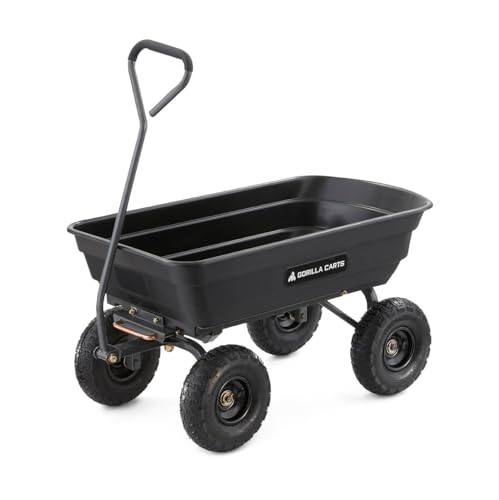
Shop Pneumatic vs Flat-Free Tires: Which Is Best for You? on Amazon
🍂 The Silent Lawn Killer: Damp Leaves Will Suffocate Your Grass
Trapped wet leaves create a breeding ground for destructive snow mold. Clear the yard fast with a high-power cordless blower before the ground freezes.